EHR Integration for Digital Health Vendors
When a hospital likes your product, the next question is whether it works with their EHR. We connect your product to Epic, Oracle Health (Cerner) and other EHR/EMR systems over HL7 and FHIR, and keep it working as you add customers.

What EHR/EMR integration covers
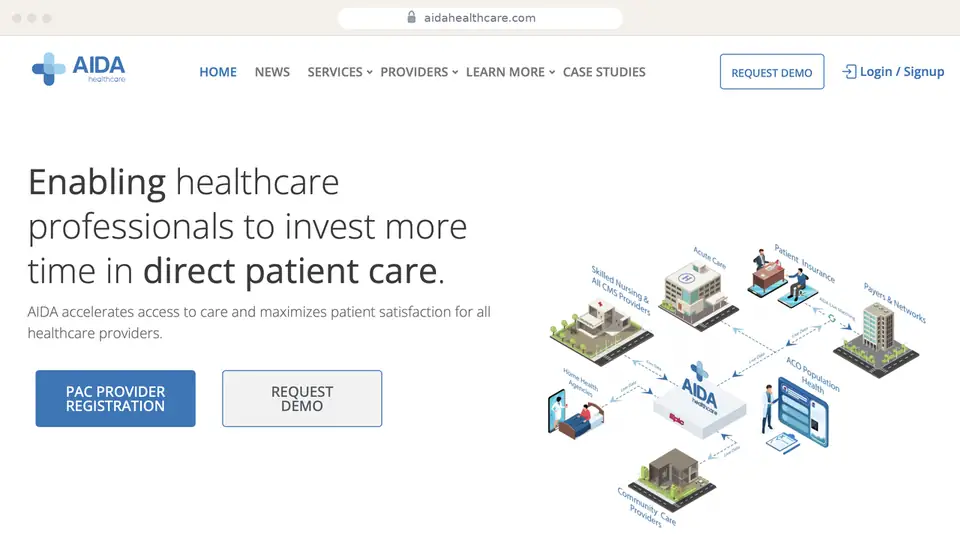
For AIDA Healthcare, integration meant case managers open AIDA from the patient chart and send a referral without retyping anything. Your product will need something different, but the work usually comes down to this:
Connecting to each EHR
Through the EHR's FHIR APIs or its HL7 v2 interfaces, whichever the hospital has. AIDA runs in both Epic and Oracle Health (Cerner).
Opening your product from the chart
Users click once inside the EHR and land in your product with the right patient already loaded. No second login.
Mapping and checking the data
Every hospital names and codes things a little differently. We map it to your data model and flag records that don't fit, so problems are caught early instead of found by a user.
Security and HIPAA
Hosting, access rules and audit logs that hold up in a hospital's security review. AIDA is a HIPAA-compliant web application.
Reports on what moves
Once data flows, you can show hospitals results. AIDA's dashboards show how fast each post-acute provider answers.
Support after go-live
When a hospital or an EHR upgrade changes something, the engineers who built the connection fix it.
EHR integration for startups and SaaS: from the first hospital to the next
The first hospital usually takes the longest. The point is to make the second one, and the tenth, faster.
- DiscoveryWe look at your workflow and the EHRs your customers use, and agree on what data has to move.
- Integration layerOne API for your product. Behind it, a connector for each EHR.
- First hospitalWe set it up with the hospital's IT team and get through their security review.
- Next hospitalsMost of the work is reused, so the next hospital is mainly configuration.
- SupportWe watch it in production and adjust when a hospital or an EHR changes something.
Selected EHR integration projects
A few examples from our case studies. Each product belongs to our client; we designed, built and support it. All case studies
Read more on EHR integration
EHR integration: questions
What digital health vendors ask us before the first call.
How long does EHR integration take for a startup?
It depends on the EHRs, the data and the workflow. Scoping usually takes 10 to 40 hours and ends with a plan and an estimate. Go-live at each hospital also depends on its IT team; for Amplify Rx we designed a model that brings a new health system live in 30 days or less.
Aggregator, direct API or custom integration?
An aggregator can get you data from many EHRs quickly. Direct APIs and a custom layer give you more control over the workflow and the data. Many vendors combine them, and we work out the right mix in discovery.
Which EHR and EMR systems do you integrate with?
Epic, Oracle Health (Cerner) and other EHR/EMR systems, over HL7 and FHIR.
What does the hospital need to do?
Every health system approves access on its side: configuration, security review and a go-live date with its IT team. We prepare what they need and work with them directly.
Who owns the integration?
You do. The code lives in your repository from the start, and you see working software in regular demos.


Selling to hospitals that run different EHRs?
Book 30 minutes with Michael Nikitin, our CEO. Bring the list of EHRs your customers use.