


Why Healthcare AI Teams Over-Invest in Models and Under-Invest in Data Pipelines
What AI for EHR Integration Actually Requires
The FHIR Data Normalization Problem No One Warns You About
Real-Time vs. Batch: Choosing the Right Clinical Data Pipeline Architecture
Data Quality Monitoring as a First-Class EHR Interoperability Concern
Using AI for EHR Integration Across Multiple Vendors Without Breaking Your Model
Why Your Healthcare Data Pipeline Needs Write-Back from Day One
Key Takeaways
FAQ
Your model works in the notebook. Precision looks great on your curated dataset. Then you connect to a live EHR, and everything falls apart – not because the model is wrong, but because the data feeding it is inconsistent, late, or structured in ways your training pipeline never anticipated. This is the most common pattern we see when startups attempt AI for EHR integration without first investing in the infrastructure underneath. If you’re a founder or technical lead building AI in healthcare, and you’re trying to figure out why your model underperforms after go-live, start here.
Why Healthcare AI Teams Over-Invest in Models and Under-Invest in Data Pipelines
The instinct makes sense: your AI model is the product differentiator, so that’s where the engineering hours go. But in clinical environments, the model is often the least fragile part of the stack. What breaks is everything upstream – the extract, the transform, the normalization, the timing.
Consider a prediction model trained on clean, structured lab values. In production, it encounters the same lab coded three different ways across two hospital systems. Performance drops, and the team starts questioning the model. But the model isn’t the problem – the data reaching it is. Teams consistently underestimate how much of their “model accuracy problem” is actually a data delivery problem, and a FHIR endpoint doesn’t solve it. FHIR gives you access, not quality. You still need transformation logic, terminology mapping, and validation layers before anything reaches your model.
If you’re spending 80% of engineering time on model development and 20% on your healthcare data pipeline, flip it, at least during the integration phase. The pipeline work is where production reliability lives.
What AI for EHR Integration Actually Requires

Connecting to an EHR isn’t just about getting an API credential and pulling data. AI for EHR integration demands infrastructure capabilities that generic data engineering doesn’t cover.
Five Infrastructure Capabilities You Can’t Skip
Terminology translation
Your integration layer needs to handle mapping across LOINC, SNOMED CT, ICD-10, RxNorm, and the local codes that map to none of the above. Without consistent coding, your model receives different representations of the same clinical concept depending on which system sent the data.
Temporal alignment
Clinical events don’t arrive in order – an encounter note might be finalized hours after the labs it references. Your pipeline needs reconciliation logic to sort these timelines before your model sees them.
Patient identity resolution
Matching patients across systems (or even across departments within the same system) requires MPI logic or a clear matching strategy. FHIR resources reference patients, but the references aren’t always consistent.
Authorization-scoped access
SMART on FHIR scopes determine what you can read and when. Your architecture needs to handle those constraints without silently dropping data.
Volume variability
A 50-provider clinic and a 2,000-bed health system produce wildly different data volumes. Your pipeline can’t require rearchitecting every time you onboard a larger customer.
Consultant’s Tip: Map your model’s input schema to actual FHIR resource fields before you write a single line of integration code. This exercise alone reveals gaps – fields your model expects that don’t exist in standard FHIR profiles, or fields that exist but are populated inconsistently.
The earlier you design for these constraints, the less rework you face. We often see teams discover these requirements after they’ve already committed to a pipeline architecture that can’t accommodate them. If you need help with this, Itirra can walk you through it.
The FHIR Data Normalization Problem No One Warns You About
FHIR gives you a standard data format, but it does not give you standard data content. This distinction trips up nearly every team building clinical data pipelines for AI.
Two health systems both send you a FHIR Observation resource for hemoglobin A1c. The structure is identical. But one codes it with LOINC 4548-4, the other uses a local code mapped internally to a different LOINC. One sends the value as a percentage, the other as mmol/mol. Both are valid FHIR. Neither is plug-and-play for your model.
Common Mistake: Assuming your FHIR-compliant pipeline handles normalization because it parses resources correctly. Parsing and normalizing are different problems. You need an explicit normalization layer with terminology services and unit conversion logic.
Where Normalization Hits Hardest
Lab results: code mapping, unit harmonization, and reference range alignment. A “normal” result in one system may be flagged in another.
Medication data: RxNorm normalization is essential, but many EHRs send medications with local formulary codes that require a separate lookup step.
Problem lists and diagnoses: ICD-10 code granularity differs by provider. Some document to the 7th character; others stop at 3. Your model needs a consistent level of specificity, or you need to handle the variation explicitly.
Real-Time vs. Batch: Choosing the Right Clinical Data Pipeline Architecture
This decision shapes your entire clinical data pipeline architecture, and many teams make it based on assumptions rather than requirements.
Real-time pipelines (event-driven, using FHIR Subscriptions or webhook-based triggers) make sense when your product needs to act on clinical data as it’s created: clinical decision support alerts, real-time risk scoring, or time-sensitive notifications. The trade-off: real-time adds complexity in error handling, backpressure, and ordering guarantees.
Batch pipelines (scheduled pulls using FHIR Bulk Data or periodic API queries) are appropriate when freshness measured in hours is acceptable – population health analytics, retrospective quality measures, billing optimization.
A Decision Framework
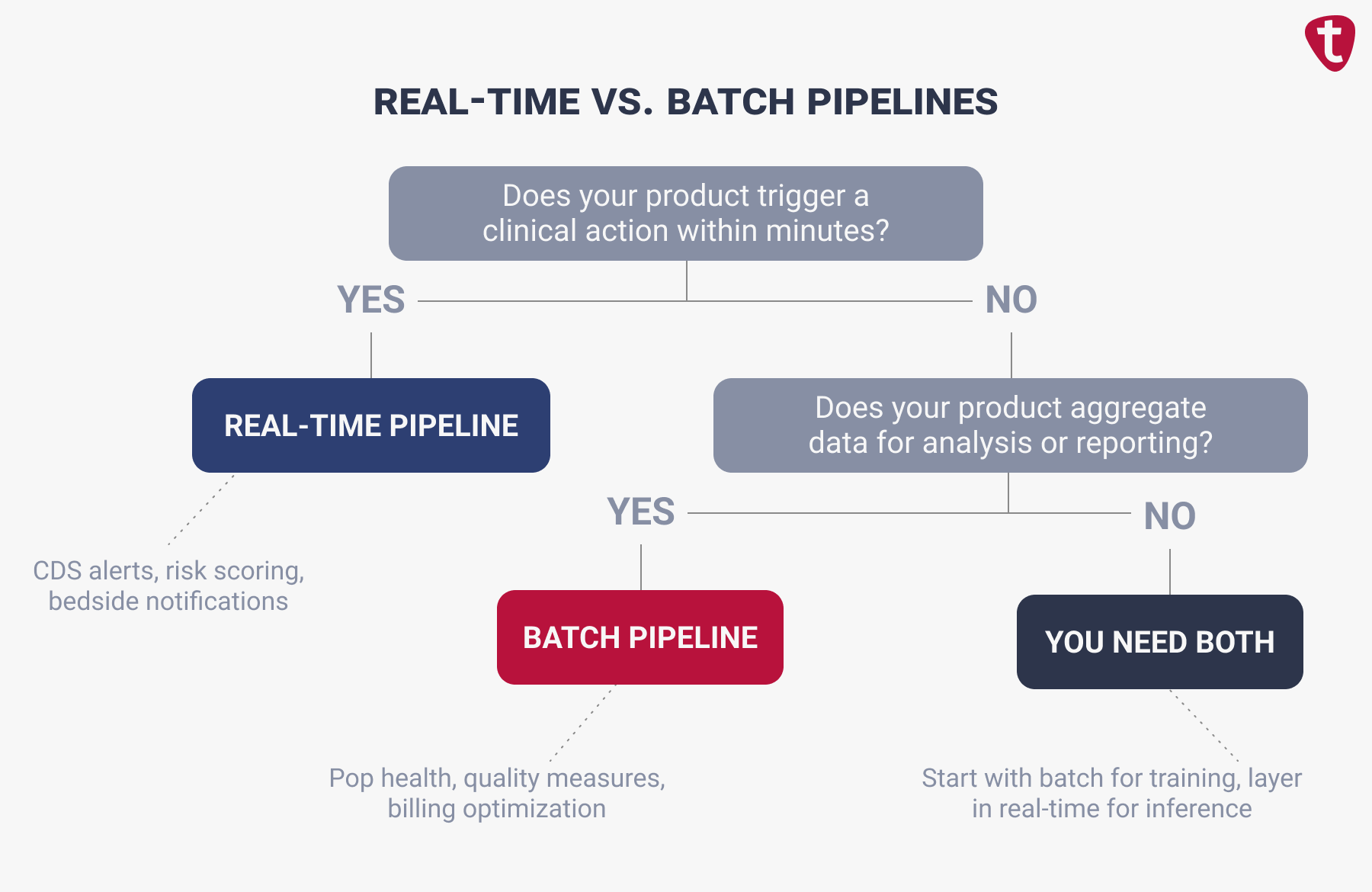
Common Mistake: Building a real-time pipeline from day one because it feels more “production-ready.” Start with batch unless your clinical workflow literally can’t tolerate a delay.
Not every EHR supports FHIR Subscriptions consistently, and Bulk Data APIs have rate limits that vary by vendor. Confirm what’s actually available before committing to an architecture.
Data Quality Monitoring as a First-Class EHR Interoperability Concern
Most teams add data quality monitoring late, after something breaks. In clinical data interoperability, data quality is the primary determinant of whether your AI output is trustworthy.
What to Track
Schema drift: EHR vendors update their FHIR implementations. Fields get added, deprecated, or change cardinality. Your pipeline should detect this before it corrupts your model input.
Coding consistency: monitor whether the distribution of codes changes over time. A sudden shift from SNOMED to ICD-10 for a particular data type might indicate a configuration change on the provider side.
Completeness thresholds: define minimum expected population rates for critical fields. If completeness drops from 90% to 40% after an EHR upgrade, you need an alert, not a silent degradation in model performance.
Latency monitoring: track time from clinical event to data availability. Spikes can indicate connection issues, API throttling, or changes in the EHR’s data export behavior.
For any team serious about clinical data interoperability, set up data quality dashboards before you go live with your first customer. Define “acceptable” ranges during pilot so you have baselines to alert against in production.
Using AI for EHR Integration Across Multiple Vendors Without Breaking Your Model
Your first EHR integration will shape your architecture. Your second will break it, unless you planned for variation from the start.
Every EHR vendor implements FHIR differently: how they populate fields, what extensions they use, which terminology standards they default to, and how they handle edge cases like amended results. A model trained on data from one vendor may underperform on another, even if both are “FHIR R4 compliant.”
Four Steps to a Multi-Vendor Pipeline

- Abstract your model inputs behind a canonical data layer. Define your own internal schema for how your model expects to receive data. Map each vendor’s output into this canonical form.
- Version your mappings per vendor and per EHR instance. The same EHR product can be configured differently at different health systems. Don’t assume “Epic” means “one mapping.”
- Test with real data from each vendor before committing to production. Synthetic data won’t reveal the quirks that real clinical data exposes.
- Maintain vendor-specific adapter logic separately from your core pipeline. When vendor A changes their implementation, you should be able to update that adapter without touching anything else.
At Itirra, we’ve observed that teams who invest in a canonical data model early (before their second vendor integration) spend significantly less time on rework than teams who try to generalize after the fact.
Why Your Healthcare Data Pipeline Needs Write-Back from Day One
Read-only integrations are simpler to build. They’re also limited in clinical value. If your AI generates insights, risk scores, or documentation, those outputs need to flow back into the clinician’s workflow, which means writing data back to the EHR.
Why Write-Back Is Harder
Write-back carries regulatory exposure that read-only integrations don’t – every write to a medical record needs to be accurate, attributed, and auditable. Beyond compliance, there’s the adoption question: a risk score that lives in a separate dashboard sees far less clinical use than one embedded directly in the EHR workflow, and enabling that integration adds technical complexity. Most EHR vendors also require a formal review process for apps that write data, with specific requirements around data provenance and user attribution that can extend your timeline by months.
Plan the Architecture Now, Ship It Later
Design your pipeline for write-back from the beginning, even if you don’t implement it in v1. That means output schemas in your data model, write scopes in your auth infrastructure, and bidirectional data flow in your architecture.
Consultant’s Tip: If your product roadmap includes write-back within 12 months, start the EHR vendor approval process now. Many teams are surprised by how long the review cycle takes, especially for apps that write clinical data rather than administrative data.
Key Takeaways
- Audit your data before tuning your model. Run the first 1,000 production records against your training schema – most teams find at least three material discrepancies.
- Build an explicit normalization layer with terminology mapping and unit conversion. FHIR compliance doesn’t equal data consistency.
- Start with batch, layer in real-time. Match your architecture to your clinical workflow requirements, not assumptions about what “production” means.
- Invest in a canonical data model before your second vendor integration. This single decision determines how much rework you face at scale.
- Design for write-back structurally from day one, even if you ship read-only first. Start the vendor approval process early.
If your team is navigating these decisions and wants to avoid the most expensive mistakes, Itirra can help you get the pipeline architecture right before you scale. Schedule a consultation to review your specific case.
FAQ
Almost always, the gap is in data consistency. Different coding standards, missing fields, unit mismatches, and timing discrepancies introduce noise your model wasn’t trained to handle. Start by auditing production data against your training schema.
Only if your product triggers clinical actions within minutes. For population analytics, billing, or retrospective analysis, batch is simpler and cheaper. If you need real-time eventually, start with batch for training and validation first.
Significantly. The FHIR specification allows wide latitude in which resources are supported, how fields are populated, and what extensions are used. Two “FHIR R4 compliant” systems can deliver the same clinical concept (let’s say, a medication order or a lab result) in structurally different ways. Field mappings that work perfectly against one vendor may silently break against another. Always validate your pipeline against real data from each vendor before committing to a production rollout.
Generally no. The same product is configured differently at each health system – custom fields, local terminology preferences, different modules enabled. Treat each deployment as a separate validation target.
A FHIR client handling auth and pagination, a normalization layer for critical data types (labs, meds, diagnoses), basic data quality checks, and a canonical data model between the EHR and your model. Build this before you optimize the model.