


Key Takeaways
Why RCM Needs to Move Beyond Billing
What “Execution System” Actually Means in Practice
FHIR and EHR Integration as the Backbone
Integration Patterns That Scale
The Role of AI in Modern RCM
From Claims to Clinical Execution: RCM’s Role in Value-Based Care
Choosing the Right Integration Partner for RCM Company
FAQ
Key Takeaways
- RCM must move upstream
Value-based care ties reimbursement to outcomes, not volume. RCM needs real-time clinical awareness and workflow triggers during care delivery – it can’t wait for claims. - Execution system = observe → trigger → close the loop
Execution systems add what billing engines don’t: real-time clinical awareness, workflow actions (not dashboards), and EHR write-back. - FHIR EHR Integration Is the Foundation
FHIR enables bidirectional workflows: reading clinical data and writing operational data back into the EHR. This makes near-real-time execution scalable across vendors.
Why RCM Needs to Move Beyond Billing
Most RCM companies traditionally focus on working with physicians to optimize documentation and adjust procedures for appropriate reimbursement, submit claims and manage denials when payers reject them, ensure diagnosis and procedure codes are accurate and complete, and handle prior authorizations so payers approve coverage before services are rendered.
These functions aren’t going away, but they’re increasingly insufficient on their own.
Value-based care (VBC) contracts are restructuring how providers get paid. Shared savings, bundled payments, capitation, quality bonuses – these models tie reimbursement to outcomes, not volume. When revenue depends on whether a care gap was closed or a readmission was prevented, the RCM function can’t sit downstream waiting for claims to be processed. It needs to be wired into clinical workflows in near-real time.

The core shift for RCM companies isn’t deciding whether to make this move; it’s defining how fast you can do it without breaking what already works. And that’s where EHR integration consulting becomes a strategic investment, not just a technical line item.
What "Execution System" Actually Means in Practice
Calling RCM an “execution system” sounds compelling on a slide. In practice, it means your platform does three things that a traditional billing engine does not.

Real-Time Clinical Awareness
Your system doesn’t wait for a claim to show up. It knows when a patient is admitted, when a lab result posts, and when a diagnosis is documented – all because it’s connected to the EHR event stream, not just the billing feed.
This matters because value-based contracts penalize gaps. Let’s say a patient with diabetes visits the clinic and no A1C is ordered – a billing system won’t notice until the quality report is due. An execution system flags it during the encounter. Building this level of clinical awareness requires specialized EHR integration consulting to navigate vendor-specific APIs, authentication patterns, and data access permissions.
Workflow Triggers, Not Just Reports
Traditional RCM generates reports. Execution-oriented RCM generates actions. A missing prior authorization triggers a task in the care team’s queue. An incomplete surgical note triggers a documentation prompt before the case is closed – not three weeks later during coding review.
Common Mistake: Building dashboards that surface insights, but don’t connect to actionable workflows. Instead, design every clinical flag with a clear “what happens next” path – a task, a notification, a queue assignment, so insights don’t just sit in a report no one opens.
Closed-Loop Feedback
The system writes back. When your platform identifies a care gap, it doesn’t just log it internally – it pushes a flag, an order suggestion, or a task back into the EHR where clinicians actually work. This closed-loop capability is what separates “analytics platform” from “execution system.”

FHIR and EHR Integration as the Backbone
None of the execution-system capabilities above work without deep, reliable EHR connectivity – the kind that requires experienced EHR integration consulting to build correctly. This is the infrastructure layer that most RCM companies underestimate and where the real competitive moat gets built.
Why FHIR Matters for RCM Specifically
FHIR gives RCM platforms a standardized way to read clinical data (Condition, Observation, Encounter, MedicationRequest) and write operational data back (Task, Flag, DocumentReference) across EHR systems. Before FHIR, most RCM integrations relied on HL7 v2 feeds and batch file drops – workable for claims, but too slow and too rigid for real-time execution.
With FHIR, you can query a patient’s active problems during an encounter, check whether required quality measures have been completed, and push a care gap alert back into the EHR – all through documented APIs rather than custom point-to-point interfaces.
The Integration Isn’t Just “Connecting to Epic”
The most common misconception is that EHR integration is a one-time technical project. For RCM execution systems, it’s an ongoing architectural concern. You need:
- Clinical event subscriptions — knowing when encounters open, close, or change status
- Order and result awareness — seeing labs, imaging, and referrals as they flow
- Documentation completeness signals — detecting missing notes or unsigned orders before they become coding problems
- Write-back channels — pushing tasks, flags, or structured summaries into the EHR
Consultant’s Tip: Start your EHR integration consulting engagement with the read-side use cases that directly impact your highest-volume denial categories. This gives you the fastest measurable ROI and builds credibility with health system IT teams before you ask for write-back permissions, which always take longer to approve.
Integration Patterns That Scale
Once you’ve committed to real EHR integration, the architectural choices matter more than most RCM teams expect. The patterns you pick early will either accelerate or constrain your ability to scale across sites, EHR vendors, and contract types.
Event-Driven vs. Batch: Choosing the Right Pattern
Not every RCM workflow needs real-time data. The right architecture usually combines both patterns, matched to the use case.
| Workflow | Pattern | Why |
|---|---|---|
| Care gap alerts during encounters | Event-driven | Must surface before the patient leaves, batch can be too late |
| Prior authorization status checks | Event-driven | Delays here directly cause claim denials |
| Quality measure calculation | Batch (nightly) | Aggregation across panels; real-time isn’t necessary |
| Denial root-cause analysis | Batch | Retrospective analysis on accumulated data |
| Documentation completeness flags | Event-driven | Must fire before the note is signed, not after |
| Financial forecasting under VBC contracts | Batch | Needs full-period data aggregation |
Common Mistake: Defaulting everything to real-time, because it sounds better on a demo. Real-time infrastructure is expensive to build and maintain. Over-indexing on event-driven patterns for workflows that are fine with nightly batches wastes engineering cycles and increases operational complexity. Match the pattern to the clinical and financial urgency.
SMART on FHIR Apps vs. Backend Services
SMART on FHIR apps launch inside the EHR. They’re ideal when a clinician or coder needs to see your RCM insights in context – care gap alerts during a visit, documentation prompts while charting, or risk score overlays on a patient panel.
Backend services run without a user session. They’re the right choice for automated workflows – nightly quality measure runs, batch eligibility checks, and automated task creation based on clinical events.
Most mature RCM execution platforms need both. The mistake is building only backend services and missing the chance to surface insights at the point of care. Check out pros and cons of both approaches to understand what’s right for you.
The Role of AI in Modern RCM
AI is already embedded in RCM workflows, and its role is expanding rapidly. But the value AI delivers depends entirely on the quality and timeliness of the data feeding it, which brings us back to EHR integration.
Where AI Is Delivering Value Today
Current AI applications in RCM cluster around a few high-impact areas:
- Coding assistance — AI models suggest diagnosis and procedure codes based on clinical documentation, reducing coder workload and catching missed codes that affect reimbursement
- Denial prediction — Machine learning models flag claims likely to be denied before submission, allowing preemptive corrections
- Prior authorization automation — AI extracts relevant clinical data and pre-populates authorization requests, cutting manual effort significantly
- Documentation improvement — Natural language processing identifies gaps in physician notes that will cause coding or compliance issues downstream
These applications work best when they have access to real-time clinical context rather than just the claim data that arrives after the fact.
Where AI Is Heading
The next wave of AI in RCM moves from assistance to autonomous action. Use cases are endless; the most important ones to head to are:
- Automatic prior auth submission when clinical criteria are met (read more about new CMS-0057-F final rule for prior auth)
- Real-time coding suggestions surfaced during documentation, not after
- Predictive models that detect patients at risk of care gaps before their next visit
- Large language models (LLMs) summarizing complex clinical histories to support appeals or peer-to-peer reviews
The trajectory is clear: AI will handle increasingly complex RCM tasks with less human oversight. But none of this works without the integration foundation.
An AI model predicting denials is only useful if it can trigger a workflow → A coding assistant is only valuable if it sees the clinical note as it’s being written → An LLM drafting an appeal letter needs access to the full clinical context, not just the claim.

Building AI-Readiness Into Your RCM Platform
AI-readiness isn’t a feature you bolt on later – it’s an architectural posture you adopt now. RCM companies that want to leverage advanced AI capabilities in the next two to three years need to be building the foundation today. That foundation comes down to five infrastructure requirements.
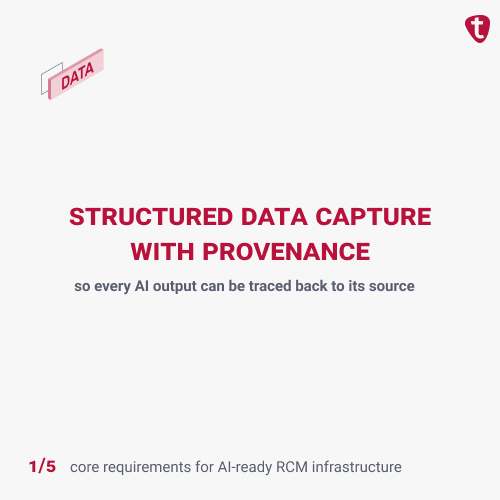
AI-readiness starts with the foundation: structured data capture with provenance. AI models are only as good as the data they learn from, so clinical inputs should be captured in structured formats with clear source system, timestamp, and lineage. In healthcare, if you can’t trace an output back to its inputs and explain why it happened, teams won’t trust it or adopt it.
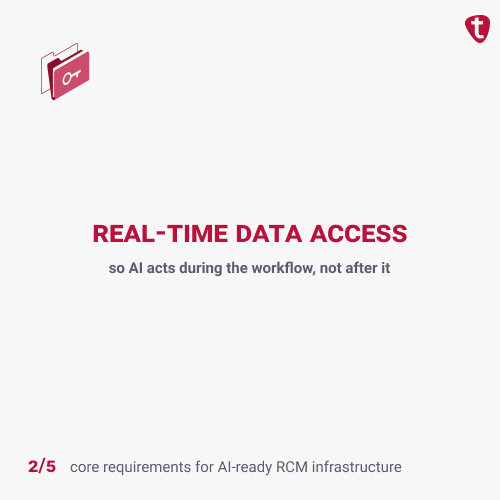
Next is real-time data access. High-impact AI needs clinical context as it’s created – during the encounter, documentation, and before submission steps, so it can influence decisions while they’re still reversible. That’s why event-driven pipelines and low-latency access matter more than nightly batch exports.
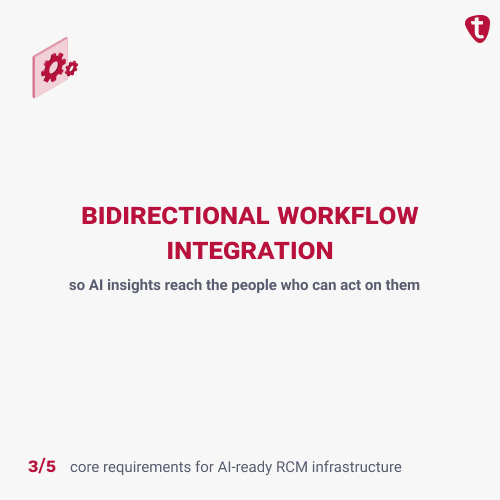
Then comes bidirectional workflow integration. Insights sitting in dashboards rarely change outcomes; AI has to reach the people who can act. The practical bar is being able to push recommendations back into the EHR or operational tools as tasks, alerts, pre-populated forms, or suggested actions, embedded directly where work happens.
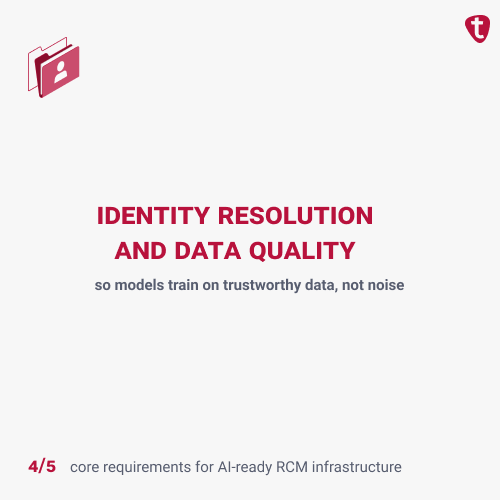
AI also depends on identity resolution and data quality. If patient records don’t match across systems, or coding and fields are inconsistent, model outputs quickly become unreliable. You don’t need perfect data, but you do need consistency supported by deterministic matching rules, validation, and ongoing quality monitoring across your integration layer.
Finally, durable AI requires feedback loops for continuous improvement. The system should capture what happened after each recommendation – whether it was accepted, modified, or rejected, and feed that signal back into the refinement process. Without this closed loop, performance plateaus; with it, the system improves in the ways that actually matter in production.
Common Mistake: Treating AI as a layer you add on top of existing RCM infrastructure or thinking of AI as “something we’ll add once we have enough data”. AI capabilities should be designed into your integration architecture from the start. Retrofitting AI onto a batch-oriented system limits you to retrospective analytics rather than real-time intervention.
From Claims to Clinical Execution: RCM's Role in Value-Based Care
Understanding the VBC Landscape
Value-based care encompasses several contract models, each with different implications for RCM:
- Shared savings programs — Providers keep a portion of savings when they reduce costs below a benchmark while meeting quality thresholds
- Bundled payments — One payment includes all services for a care episode (e.g., joint replacement), creating an incentive to reduce complications and unnecessary services
- Capitation — Providers receive a fixed per-member-per-month payment regardless of services delivered, shifting utilization risk to the provider
- Quality bonuses and penalties — Payers adjust reimbursement based on performance on specific quality measures
Each model requires RCM to track different data, trigger different workflows, and measure success differently than fee-for-service.
Why VBC Changes the RCM Value Proposition
Under fee-for-service, RCM value is measured in clean claim rates and days in A/R (Accounts Receivable). Under value-based contracts, the metrics shift dramatically:
- Care gap closure rates → Are patients getting the preventive services their contracts require?
- Risk adjustment accuracy → Is every documented condition properly captured and coded?
- Cost avoidance → Are unnecessary readmissions, ER visits, and duplicative tests being prevented?
- Quality measure performance → Are you hitting the thresholds that trigger bonuses rather than penalties?
An RCM platform that can only process claims can’t move these levers. An execution system, wired into EHR data, triggering workflows, and closing loops – can.
A Phased Roadmap for the Shift
You can’t rebuild your RCM platform overnight. You can, however, sequence the transition, so each phase delivers value and funds the next.
Phase 1: Read-Side Clinical Intelligence (Months 1–4)
Connect to EHR clinical data via FHIR, starting with Condition, Encounter, and Observation resources. Layer this on your existing claims data to identify patterns your billing-only view misses.
Phase 2: Automated Workflow Triggers (Months 3–7)
Build event-driven triggers for your highest-impact workflows: prior auth gaps, missing documentation flags, quality measure reminders.
Phase 3: Point-of-Care Integration (Months 6–12)
Deploy SMART on FHIR apps that surface insights where clinicians work. Care gap alerts during visits. Risk adjustment prompts during coding.
Phase 4: Closed-Loop Write-Back and VBC Optimization (Months 10–18)
Enable write-back to the EHR. Optimize for specific VBC contract types. Build reporting that ties your platform’s actions to contract performance.
Choosing the Right Integration Partner for RCM Company
The shift from billing engine to execution system touches every layer of your platform – data pipelines, authorization models, clinical workflows, write-back architecture. Doing that while keeping your existing revenue cycle running is the hard part. A good EHR integration partner makes this manageable by absorbing the complexity your team shouldn’t have to learn from scratch.
Specifically, the right partner compresses the work in three ways:
They’ve already mapped the vendor landscape. Every EHR has its own FHIR coverage gaps, extension quirks, authorization flows, and IT approval processes. An experienced partner knows where Epic differs from Oracle Health, which write-back paths require additional governance, and how to scope requests so health system IT teams say yes faster. Your engineers skip months of trial-and-error discovery.
They sequence the buildout so you ship value early. Without guidance, most RCM teams try to build the full integration layer before launching anything and run out of budget or patience. A partner who’s done this before designs the architecture in phases, shipping read-side wins in months while laying groundwork for write-back and AI. Each phase pays for the next.
They handle the non-technical bottlenecks. The hardest parts of EHR integration are often administrative, not technical – security reviews, data use agreements, scope approvals, and change control processes. A partner who knows these workflows keeps your project moving when your engineering team would otherwise be stuck waiting on paperwork they’ve never seen before.
When evaluating partners, the questions that reveal depth of experience are:
- Have they built integrations that combine clinical and financial data, not just one or the other?
- Can they show you a phased approach specific to your platform and your customers’ EHR mix?
- Do they understand closed-loop clinical workflows, not just read-only data pulls?
- How would they approach write-back authorization with a health system IT team?
Itirra works with healthcare companies navigating exactly this transition, combining FHIR integration consulting, EHR connectivity across major vendors, and strategic sequencing that turns an integration project into a platform capability. If you’re an RCM company evaluating how to move from a billing engine to an execution system, a focused architecture assessment is usually the right starting point. Schedule a consultation with us to plan your next steps together.
FAQ
Analytics tells you what happened. An execution system acts on what’s happening. The difference is real-time EHR connectivity, automated workflow triggers, and write-back capability – your platform doesn’t just report care gaps, it pushes alerts into clinician workflows and tracks closure.
Traditional RCM only sees data after services are completed and claims generated. Value-based contracts tie reimbursement to outcomes determined during care delivery. By the time traditional systems see the claim, it’s too late to close care gaps or ensure quality measures are met.
Underestimating write-back complexity. Reading clinical data is relatively straightforward; writing back requires stricter authorization, more rigorous testing, and longer health system approval cycles. Plan for write-back to take 2-3x longer than read-side integration.
HL7 v2 messages and file-based exchanges can move events and documents, but they’re inconsistent to map. FHIR gives you queryable APIs, standardized clinical resources, and write-back channels that HL7 v2 simply doesn’t offer. Most RCM companies keep their existing HL7 feeds for legacy workflows while building new VBC capabilities on FHIR.
AI amplifies what the execution system can do – predicting denials, suggesting codes, automating prior auth. But AI without real-time clinical data access is limited to retrospective analysis. The integration layer is what makes AI actionable rather than just informational.
Real-time infrastructure is expensive, so you need to match the pattern to urgency. Use event-driven when timing matters and encounters need real-time (prior auth gaps, documentation prompts before signing, in-visit care gaps). Use batch when aggregation matters (panel-level quality measures, trend analysis, forecasting). Most mature platforms use both – event-driven for action, batch for measurement.
It depends on whether your team has built production FHIR integrations with write-back before. If not, an experienced partner compresses the learning curve from 6+ months to 8-10 weeks and helps avoid architectural decisions that are expensive to reverse.