


What Are Member Appeals and Why They Cost More Than You Think
Prior Authorization Denials: Where Most Appeals Begin
Why Patient Appeals Get Expensive Without FHIR EHR Integration
What Clinical Data Integration Actually Fixes in the Appeals Workflow
FHIR EHR Integration for Member Appeals: Architecture and Approach
Where Appeals Integration Goes Wrong – and How a Healthcare Consultant Helps
Building Your Appeals Integration Roadmap
FAQ
What Are Member Appeals and Why They Cost More Than You Think
If you’re building a product that touches the prior authorization or claims lifecycle, you already know this pain point. A member appeal (or a patient appeal) is a formal request to overturn a health plan’s denial of coverage for a medical service. The member (or their provider acting on their behalf) submits clinical evidence arguing that the denied service is medically necessary. Without EHR integration automatically feeding that clinical evidence, the process becomes a manual, expensive grind that nobody wins.
The typical workflow: a prior auth request gets denied, someone (usually a nurse or billing specialist) manually pulls clinical documentation from the EHR (Electronic Health Record), compiles and submits it to the payer through a portal, fax, or mail, and then the payer reviews it, often requesting additional information before issuing a decision.
Each step leaks time and money. The clinical data needed to support the appeal already exists in the EHR. The problem is getting it out structured and putting it into the right hands fast enough to matter.
For digital health companies – whether you’re focused on appeals management, revenue cycle optimization, or payer-provider data exchange – this gap between “clinical data exists” and “clinical data is usable for an appeal” is where healthcare automation and FHIR (Fast Healthcare Interoperability Resources) EHR integration make the difference.
Prior Authorization Denials: Where Most Appeals Begin
Most member appeals typically don’t refer to billing disputes and rather start with a prior authorization denial – a payer decision that a requested service isn’t medically necessary or lacks sufficient documentation.
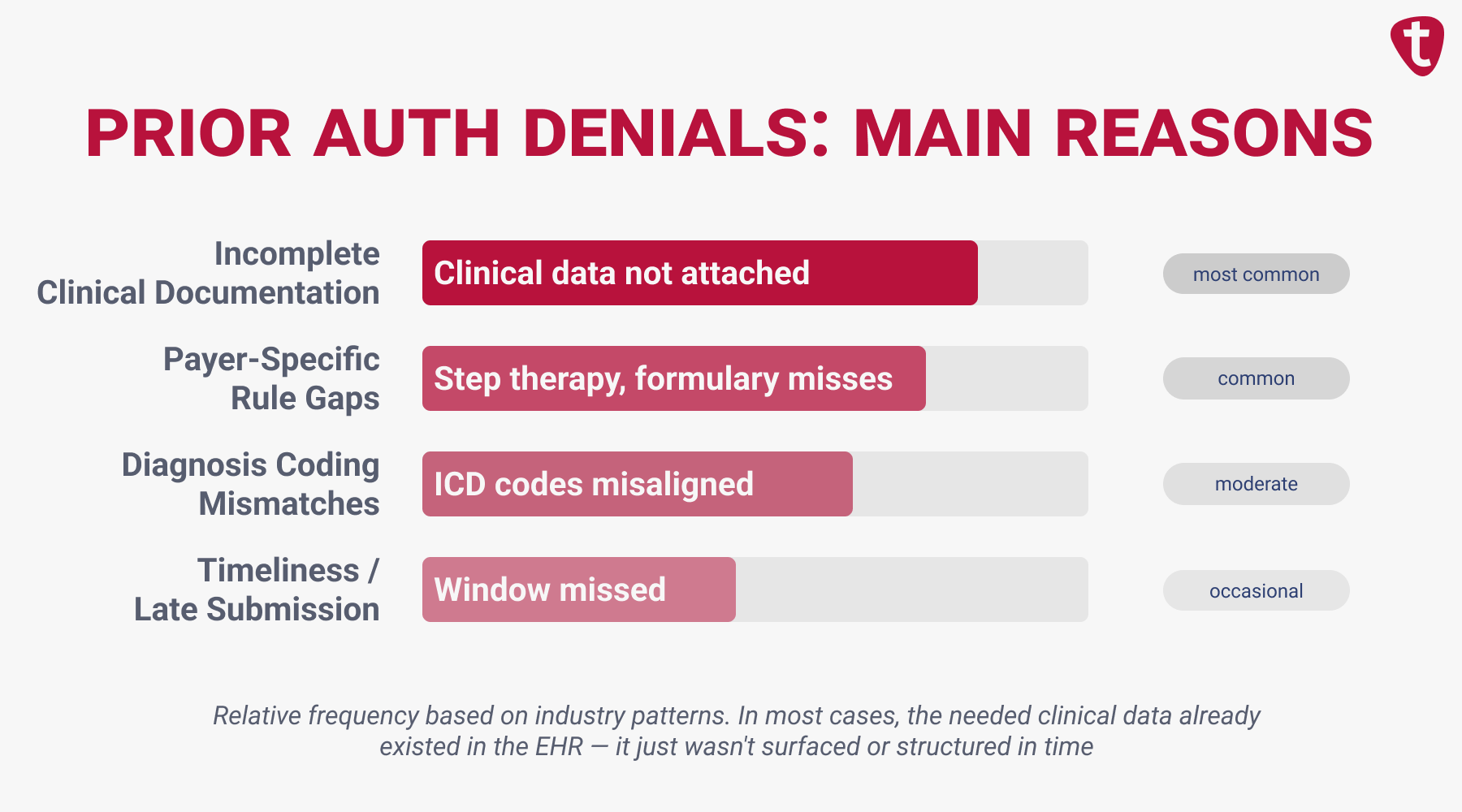
Prior auth denials are the single biggest driver of appeal volume, and the reasons cluster around a few patterns:
- Incomplete clinical documentation: The submission didn’t include enough evidence (lab results, imaging reports, clinical notes) to justify the service. The data existed in the EHR but wasn’t attached.
- Coding mismatches: Diagnosis codes didn’t align with the payer’s coverage criteria, even when the clinical picture clearly supports the service.
- Failure to meet payer-specific rules: Each payer has different medical necessity criteria, step therapy requirements, and formulary restrictions. Missing one checkbox triggers a denial.
- Timeliness: The prior auth wasn’t submitted within the payer’s required window, or follow-up documentation arrived late.
In most cases, the clinical data needed to prevent denial or win the subsequent appeal was already in the EHR. It just wasn’t surfaced, structured, or transmitted in time.
Common Mistake: Treating denials as a billing problem when they’re actually a clinical data problem. If your product only addresses appeal submission without fixing the upstream data gap, you’re solving half the problem. Build clinical data retrieval into the workflow before the denial happens.
Startups building prior auth and appeal tools need to think about EHR integration from day one – not as a “phase two” feature, but as the foundation that determines whether the product actually reduces denial rates or just makes filing paperwork slightly easier.
Why Patient Appeals Get Expensive Without FHIR EHR Integration
The real cost of a patient appeal isn’t the submission itself. It’s the labor, delay, and opportunity cost embedded in every manual step.
The Manual Data Chase
Without EHR integration, building an appeal case means someone logs into the EHR, searches for relevant encounters, copies notes and results, reformats them for the payer’s requirements, and attaches everything to the submission. For a single appeal, this takes 30 to 90 minutes of skilled staff time. Multiply that across hundreds of appeals per month, and you’re looking at significant FTE (Full-Time Equivalent) costs dedicated almost entirely to manual data retrieval.
The Delay and Rework Tax
Every day an appeal sits unresolved is a day the provider doesn’t get paid, and the patient doesn’t get care. Manual processes create bottlenecks at every handoff – waiting for chart access, waiting for clinician sign-off, waiting for documentation to be compiled.
When a payer requests additional information (which happens quite frequently), the entire cycle restarts. Each round trip adds cost and pushes resolution from days into weeks.
If your product can’t pull structured clinical data directly from the EHR, you’re asking users to do the hardest part of the job manually, which limits adoption and makes it harder to demonstrate measurable savings during pilots.
What Clinical Data Integration Actually Fixes in the Patient Appeals Workflow
EHR integration doesn’t just speed up appeals – it changes what’s possible in the workflow itself.
Automated Evidence Assembly
Instead of staff manually hunting through charts, an integrated system queries the EHR for the specific data elements a payer requires for a given denial reason. The appeal package gets assembled programmatically – Condition, Observation, MedicationRequest, and DocumentReference records pulled together based on the denial code and the payer’s known criteria.
Gap Detection and Appeal Triage
With a live connection to clinical data, your product can flag appeals that are likely to succeed versus those needing additional clinical input before submission. This triage step saves time on low-probability appeals and focuses effort where it matters.
Faster Payer-Provider Data Exchange
When both sides of the appeal can exchange structured FHIR data rather than faxed PDFs, review cycles compress. The payer gets machine-readable clinical information. The provider gets structured status updates instead of portal notifications requiring manual checking.
Upstream Denial Prevention
This is the highest-value play. If your product integrates deeply enough to analyze prior auth submissions before they go out, it can catch documentation gaps and missing clinical evidence that would trigger a denial. Preventing the denial eliminates the appeal entirely.

Common Mistake: Trying to build full denial prevention before proving value with basic evidence assembly. Start with read-only clinical data integration for appeals, demonstrate measurable time savings, then expand upstream.
FHIR EHR Integration for Member Appeals: Architecture and Approach
FHIR EHR integration for member appeals isn’t a single API call – it’s a set of integration patterns that connect your product to clinical data sources across the appeal lifecycle.
Core FHIR Resources for Appeals
The clinical evidence needed for most appeals maps to a relatively small set of FHIR resources:
- Patient – Demographics and identifiers for matching across systems.
- Condition – Active diagnoses supporting medical necessity.
- Observation – Lab results, vitals, and clinical measurements.
- MedicationRequest / MedicationStatement – Medication history, including step therapy evidence.
- DocumentReference – Clinical notes, letters of medical necessity, imaging reports.
- Procedure – Prior treatments that demonstrate the need for the requested service.
- Claim / ClaimResponse – The original claim and denial details (on the payer side).
Your integration layer needs to query these resources, filter by relevance to the specific denial reason, and compile them into a submission-ready package.
Authentication and Access
Most clinical data for appeals lives in the provider’s EHR. Accessing it means registering your application with the EHR vendor (Epic, Oracle Health (Cerner), etc.), implementing SMART on FHIR for authorization, and navigating the health system’s security review process.
On the payer side, the CMS Interoperability and Prior Authorization Final Rule is pushing health plans toward FHIR-based APIs for prior auth and claims data. This regulatory tailwind is real, but implementation timelines vary by payer.
Where Appeals Integration Goes Wrong – and How a Healthcare Consultant Helps
Building FHIR EHR integration for appeals workflows has its own failure modes. Most aren’t purely technical – they’re about underestimating the operational and regulatory complexity around clinical data.
Ignoring Payer Variation
Each payer has different medical necessity criteria, documentation requirements, and submission formats. If your architecture doesn’t account for payer-specific rules as configuration rather than hard-coded logic, you’ll rebuild for every new payer relationship.
Underestimating Clinical Data Quality
FHIR gives you structured access to EHR data, but “structured” doesn’t always mean “complete” or “consistent.” Diagnosis codes may be outdated. Clinical notes may be free text rather than discrete fields. Lab results may use local codes instead of LOINC.
Common Mistake: Assuming that connecting to a FHIR endpoint means you’ll get clean, complete clinical data for every appeal. Build data quality checks and fallback workflows (like prompting staff to fill gaps) into your product from the start.
Skipping the Provider Workflow
An appeals tool that requires providers to change how they document will struggle with adoption. The integration needs to work within existing clinical workflows – pulling data that’s already captured, not requiring new documentation steps.
Where a Healthcare Consultant Adds Value
An experienced EHR integration consulting partner helps you navigate these realities:
- Mapping payer-specific requirements into a configurable rules engine instead of one-off code.
- Validating which FHIR resources are reliably populated in target EHR environments.
- Designing architecture that scales from one health system to many without structural rewrites.
- Handling security reviews, BAA (Business Associate Agreement) negotiations, and vendor registration processes that add months if you’re doing them for the first time.
This is where healthcare consulting pays for itself – not in writing API calls, but in avoiding the architectural dead ends that stall products for quarters. Contact us today to find out more about your specific case.
Building Your Appeals Integration Roadmap
You don’t need to solve the entire appeals workflow on day one. A phased approach proves value early and expands as your product matures.
Phase 1: Read-Only Evidence Assembly (Months 1–3)
- Connect to one EHR environment
- Pull clinical data for the most common denial types
- Demonstrate measurable time savings in appeal preparation for your first pilot customer
Phase 2: Structured Submission and Status Tracking (Months 3–6)
- Compile and submit appeal packages in structured formats
- Integrate status tracking so users aren’t logging into payer portals manually
- Begin supporting a second EHR vendor or additional sites
Phase 3: Payer-Provider Data Exchange (Months 6–12)
Build bi-directional exchange where payers can request and receive structured clinical data through your platform
Phase 4: Upstream Denial Prevention (Months 12+)
Layer in pre-submission analysis that catches documentation gaps before the prior auth goes out. This is the highest-value capability, but it requires deep integration on both the provider and payer sides.
Consultant’s Tip: Sequence your roadmap around your first paying customer’s denial volume. Ask them for their top five denial reason codes by volume. Build your Phase 1 evidence assembly around those specific codes. This keeps scope tight and makes ROI easy to measure during the pilot.
Itirra works with digital health teams as an EHR integration partner, helping scope and build these integrations – especially in the early phases, when architecture decisions lock in your product’s scalability or limit it. If you’re mapping out your appeals integration roadmap, a focused consulting engagement can compress your timeline and avoid the missteps outlined above.
FAQ
A member appeal is a formal request to reverse a health plan’s denial of coverage. The member or their provider submits clinical evidence arguing that the denied service is medically necessary. Appeals are most commonly triggered by prior authorization denials and follow a payer-defined review process, as well as state and federal regulations.
They’re the same thing. “Member appeal” is the payer-side term (since the person is a plan member), while “patient appeal” is more common on the provider side. The workflow, data requirements, and integration needs are identical regardless of which term is used.
FHIR integration connects healthcare systems through standardized APIs. For appeals, the clinical evidence needed – diagnoses, lab results, medications, clinical notes – already exists in the EHR. FHIR provides a standardized way to pull that data programmatically, instead of manually, cutting appeal preparation time and enabling automation that isn’t possible with faxes or portal uploads.
Yes, but it doesn’t scale well. Custom integrations, HL7 v2 feeds, or manual extraction require site-by-site customization and miss the regulatory momentum pushing payers and providers toward FHIR-based data exchange. Starting with FHIR gives you a foundation that works across EHR vendors and aligns with where the industry is headed.
A realistic range is 3–6 months for a first production integration, including vendor registration, security review, and testing. The technical build is often the faster part – administrative approvals drive most of the timeline. Experienced healthcare consulting support compresses this by anticipating bottlenecks and using pre-validated patterns.