

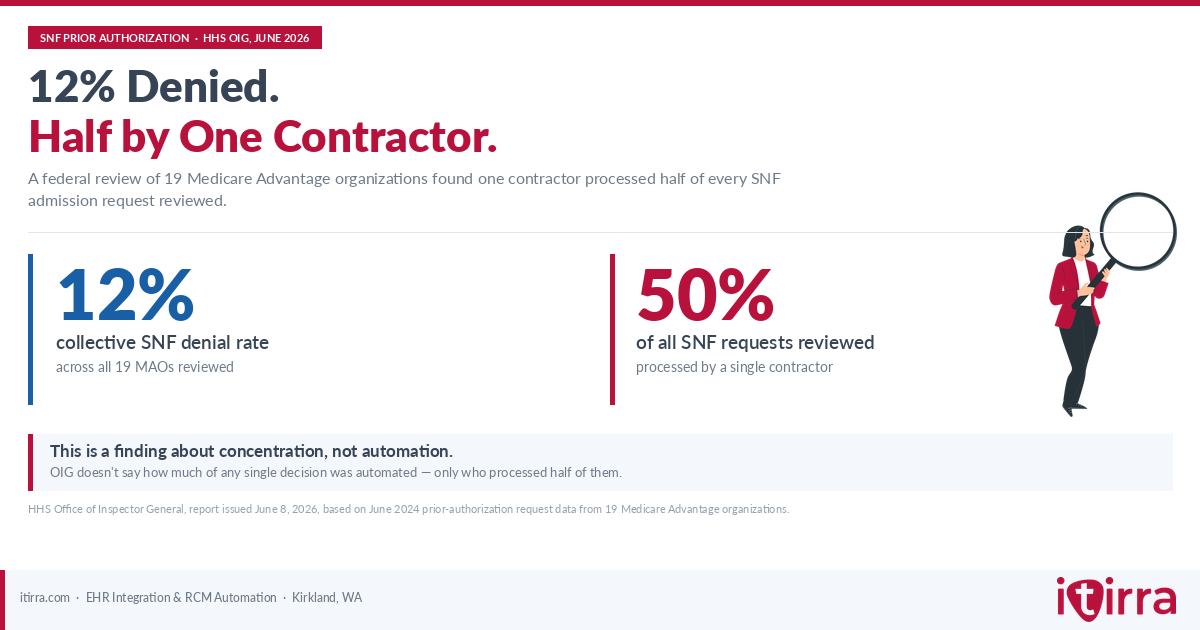
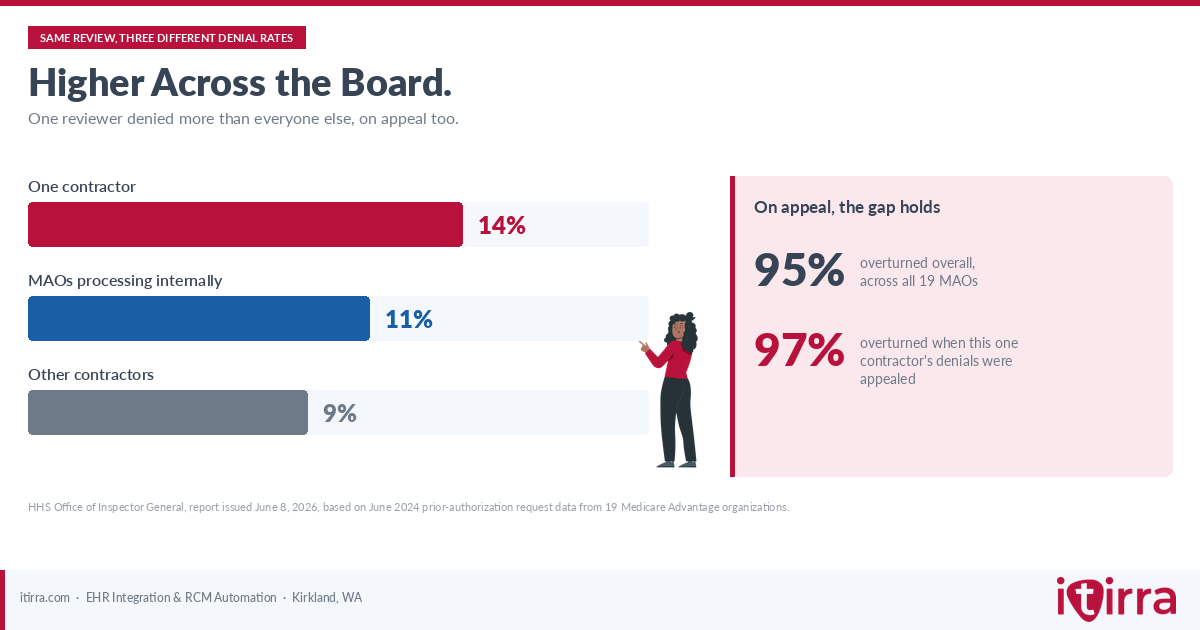
A federal review of 19 Medicare Advantage organizations found they collectively denied 12% of skilled nursing facility admission requests — a rate that ranged from 0.4% to 23% depending on the organization. But averages hide the more useful finding here: one contractor processed half of every SNF request in that review, and denied them at a higher rate than anyone else in the sample — 14%, against 11% for MAOs reviewing internally and 9% for other contractors.
Why Does Concentration Matter More Than the Average?
Because a single contractor’s practices, not nineteen separate ones, shaped half of what this review measured. OIG’s own recommendation to CMS follows directly: collect prior-authorization data at the contractor level, not just the MAO level, and examine why rates vary this much. What the report does not establish is how much of any individual determination was automated, or whether a human reviewer agreed with a given recommendation — it measures who processed the request and what happened next, not how the decision was made.
On appeal, the same contractor’s denials were overturned even more often than the group average — 97% versus 95% overall. That doesn’t prove every unappealed denial would have gone the same way. OIG said the rate raises concerns about breakdowns in initial review and about the training and oversight MAOs provide to the contractors doing this work.
Is This One Federal Investigation, or Three?
It’s tempting to read the SNF finding, the Senate letters, and an ongoing lawsuit as one story. They aren’t, and treating them that way overstates each one.
The OIG report above is public, final, oversight-level analysis. The Senate letters, dated July 14, 2026 — from Senator Blumenthal, Ranking Member of the Permanent Subcommittee on Investigations, and Senator Hawley — are a congressional records request to the three largest MA insurers, not a subpoena. They cite the OIG data directly and ask a pointed forward-looking question: whether it remains company policy that final adverse determinations can’t be made by AI or other predictive technologies. One insurer’s letter separately noted a 72% denial rate for inpatient rehab requests (against a 41% average for 16 smaller insurers) and a 13.5% SNF denial rate described as among the highest observed. Response deadline was July 28, 2026; no reply has been publicly reported as of this writing.
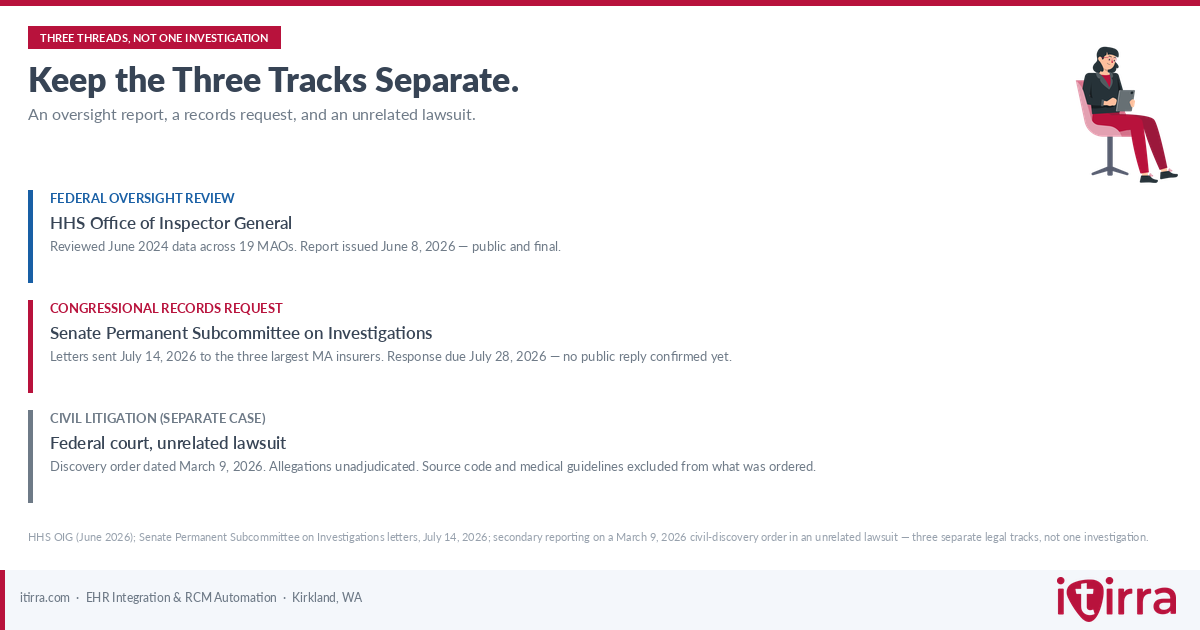
The court case is a different matter entirely: an unrelated civil lawsuit — a proposed class action from the families of two deceased MA members — where a federal magistrate reportedly ordered one insurer to produce internal records tied to a predictive care-support tool. Six of seven requested categories were granted; source code, underlying medical guidelines, broad financial data, and disciplinary records were not. The insurer’s position is that physicians, not the tool, make medical-necessity calls under CMS guidance. The allegations remain unproven.
What Does This Mean for a SNF Operator?
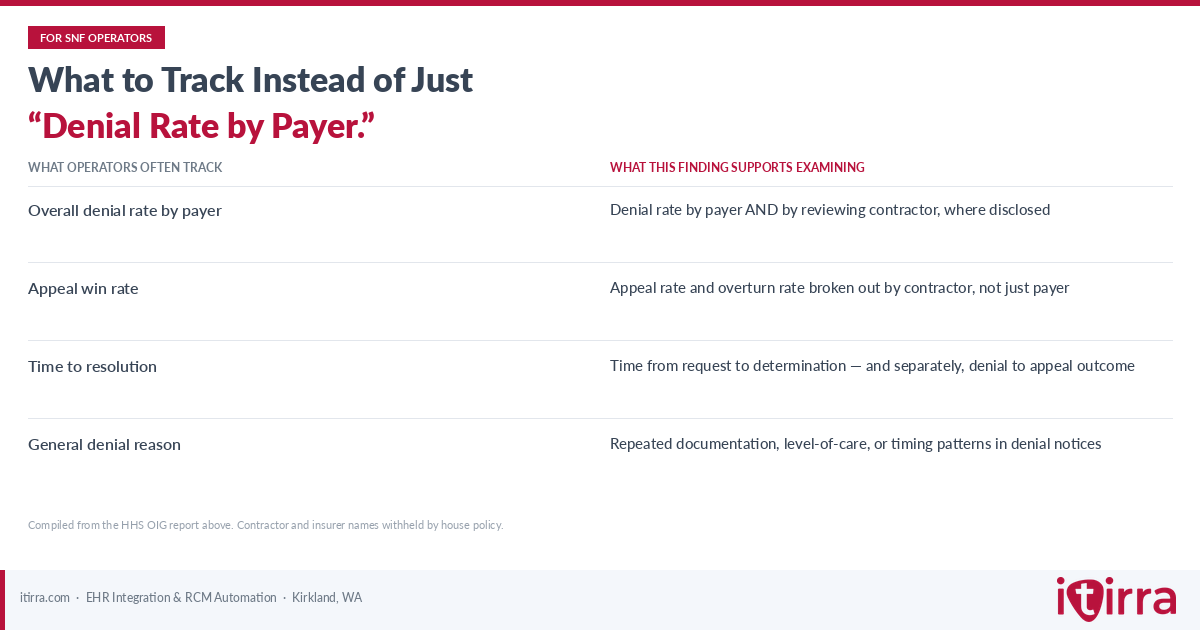
If a large share of a payer’s SNF reviews actually runs through one contractor, that contractor’s specific practices are worth understanding on their own terms — not folded into a single “denial rate by payer” figure.
Where Does This Leave the Story?
Unresolved, on purpose, and made of three threads that shouldn’t be flattened into one. Keeping them apart is more honest than a single headline claim — and together, they’re still the clearest public picture yet of how concentrated SNF prior-authorization review has become.
Frequently Asked Questions
What percentage of SNF admission requests do Medicare Advantage insurers deny?
12% collectively across 19 MAOs reviewed by HHS OIG (June 2024 data, report issued June 8, 2026), ranging from 0.4% to 23% by organization.
Did one contractor process most SNF admission requests in OIG’s review?
Yes — half of all requests in the sample, at a 14% denial rate versus 11% for internal MAO processing and 9% for other contractors. That’s a finding about concentration within OIG’s 19-MAO sample, not nationwide responsibility for SNF denials.
Is this connected to the Senate’s inquiry into AI and Medicare Advantage denials?
Related, not identical. The July 14, 2026 Senate letters cited this OIG data and asked whether AI is barred from making final coverage determinations — a congressional records request, not a finding of wrongdoing.
Has a court ordered an insurer to disclose how a predictive tool works?
In an unrelated civil lawsuit, a federal magistrate reportedly ordered one insurer to produce policies and governance records tied to such a tool, explicitly excluding its source code and medical guidelines. The case remains unresolved.
Ready to talk?
Seeing post-acute denials cluster around one payer contractor?
That pattern is visible in your own data long before it reaches a hearing.
Sources
- “Medicare Advantage Organizations Overturned Nearly All Appealed Prior Authorization Denials for Skilled Nursing Facility Admission” — HHS Office of Inspector General, issued June 8, 2026
- Senate Permanent Subcommittee on Investigations — letter to insurer, July 14, 2026
- “Senators press Medicare Advantage insurers on AI-driven coverage decisions” — Becker’s Payer Issues, July 15, 2026
- “Judge orders broad discovery in AI coverage denial case” — Becker’s Payer Issues, March 11, 2026. Independently corroborated across multiple legal-industry sources; case-identifying details withheld by editorial decision.