

What Epic announced around Open@Epic 2026, what it means for hospitals, and what to watch before 2027.
Open@Epic 2026, Epic’s conference for app developers, health systems and standards experts, wrapped up on October 22 in Verona, Wisconsin. The biggest news came as it opened: Epic announced Connectors, a way for its AI tools to pull information from third-party apps and complete tasks in them, with the first Connectors planned for Epic’s app marketplace in March 2027 (Epic, Oct 2026).
We work on EHR integrations every day, so we followed the week closely. Here is what was announced, what it means for hospitals and software vendors, and the questions to ask before 2027. Everything below comes from public sources.
Key takeaways
- Connectors: Epic’s AI tools will read from and act in third-party apps, starting March 2027, with each hospital’s approval before data flows.
- From the keynote: AI chatbots are adding traffic to hospital EHRs, and faster bulk data exports need hardware health systems pay for.
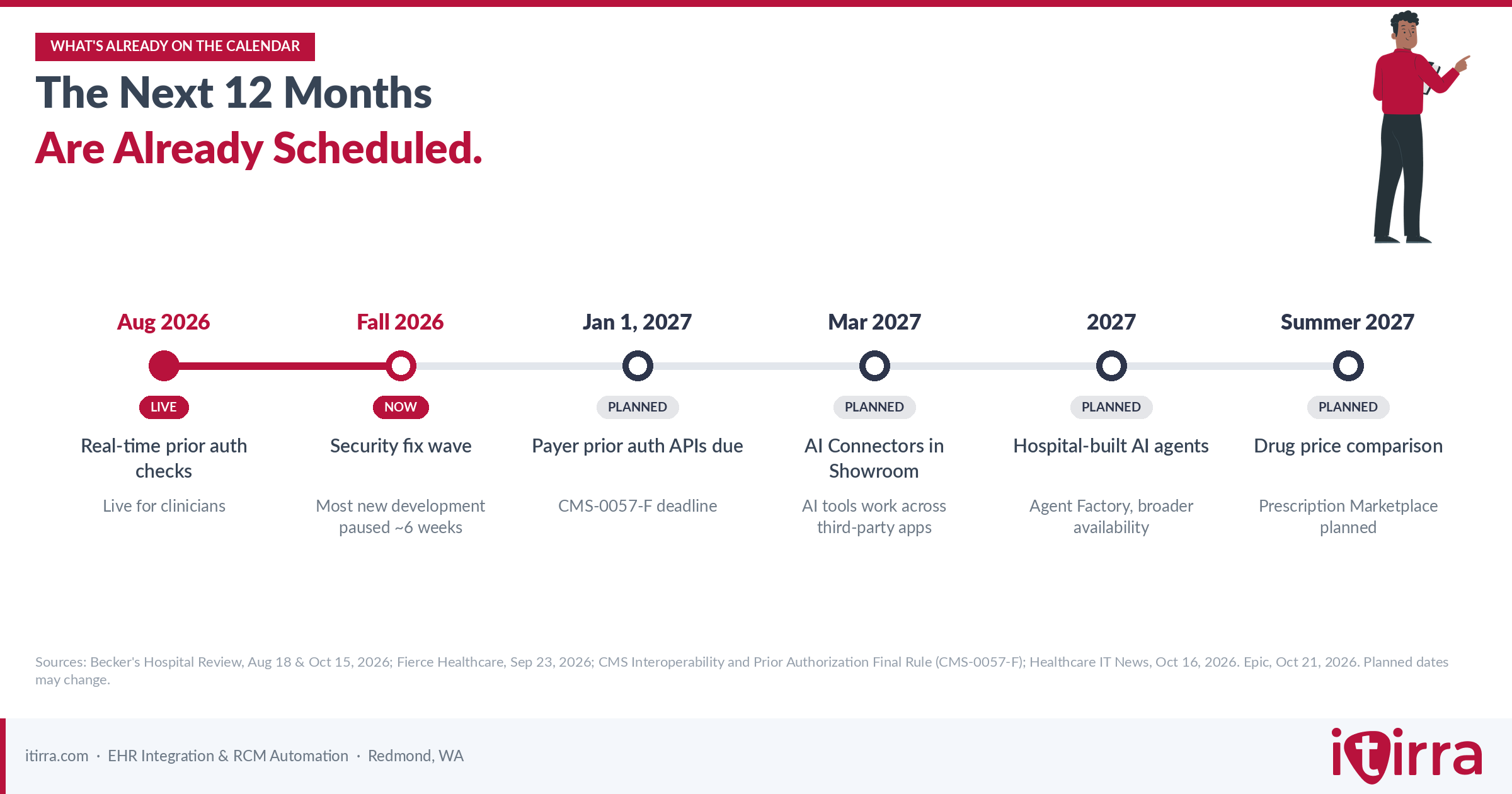
- Prior authorization: real-time checks are live; payer Prior Authorization APIs are due January 1, 2027.
- What to do: know every app connected to your EHR, what it can read and change, and who owns it.
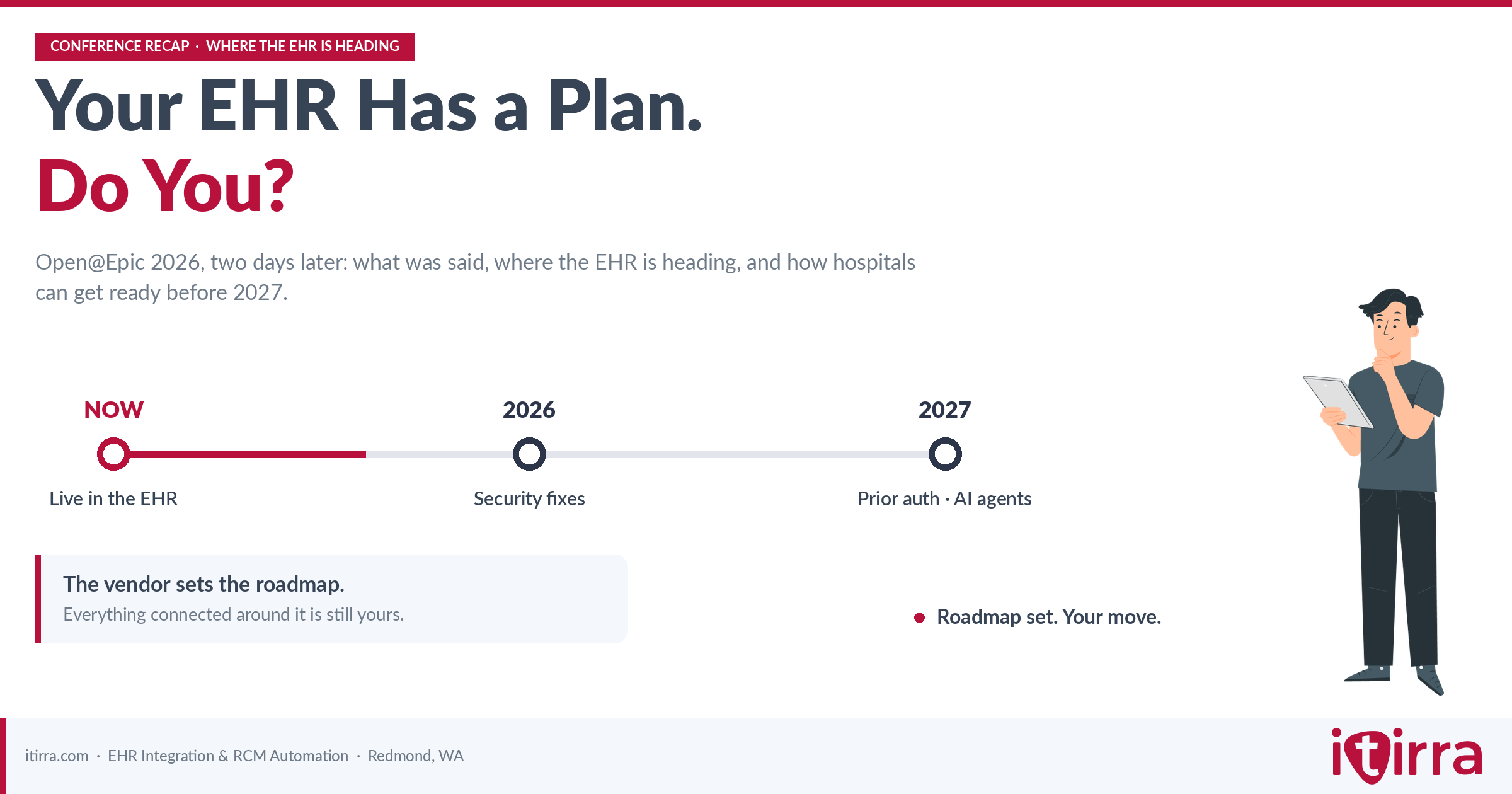
What did Epic announce at Open@Epic 2026?
Seth Howard, Epic’s executive vice president of R&D, opened the conference on October 21. Four things stood out (Epic; Becker’s Hospital Review, Oct 22, 2026).
Connectors: Epic’s AI starts working in other apps
Epic Connectors are integrations, built by app developers, that let Epic’s AI tools, including Emmie for patients, Art for clinicians, Penny for revenue cycle and agents built in Agent Factory, pull information from other apps and complete tasks in them. Epic’s examples: an ambulance app sending arrival times to the emergency department, or a patient ordering a meal through the hospital’s dietary app (Epic, Oct 2026). “We are creating Agent Factory connectors, so Epic AI agents in Factory can communicate with external software,” Howard said (Becker’s Hospital Review, Oct 22, 2026).
- Standard: Model Context Protocol (MCP) at launch, possibly a different one later (Fierce Healthcare, Oct 2026).
- Timing: first customers as soon as November; Connectors in Showroom, Epic’s app marketplace, from March 2027 (Becker’s; Epic).
- Control: the hospital reviews what each Connector can do, read and change, and data doesn’t flow until its security, legal and compliance teams approve (Fierce Healthcare).
Epic hasn’t yet said how finely permissions can be set, how a Connector is switched off, what audit logs record, or who is accountable when an action across two systems fails (healthsystemCIO, Oct 2026).
From the keynote: more traffic, more hardware
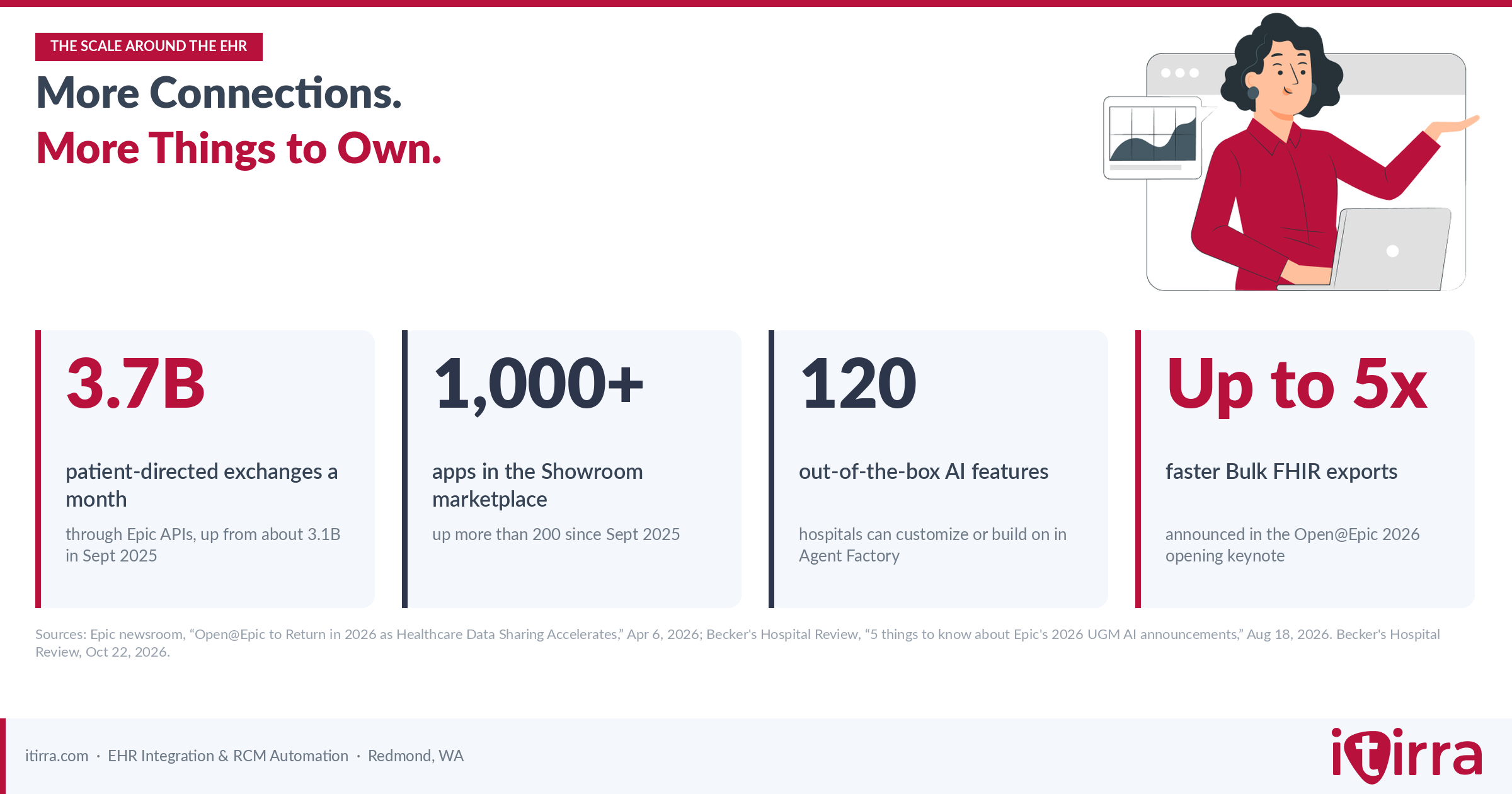
Patient apps, including AI chatbots, are adding load to hospital EHRs. “Our customers are definitely noticing the extra traffic,” Howard said; Epic’s answer is FHIR notifications, so apps get an alert when a record changes instead of polling for it. Bulk FHIR exports will run up to five times faster on a dedicated server, but “the extra hardware is not free to health systems” (Becker’s Hospital Review, Oct 22, 2026).
Prescription Marketplace and a warning about AI agents
Clinicians and patients will see pharmacy cash prices next to the insurance price before a prescription is sent, planned for summer 2027 (Healthcare IT News, Oct 2026). On the conference panel, Costco’s Ricky Li, PharmD, said Costco pharmacies get about 1,000 calls a day from AI agents asking about access to and quantities of controlled substances (Becker’s Hospital Review, Oct 22, 2026).
Prior authorization and the 2027 deadline
Real-time prior authorization checks went live in August at four health systems, with 16 more payers testing, on HL7’s FHIR-based Coverage Requirements Discovery API (Healthcare Dive, Aug 2026). Under CMS-0057-F, impacted payers must have a Prior Authorization API live by January 1, 2027 (CMS); we covered the hospital side in One Discharge. One Box. 2027. The conference also covered direct VA specialist scheduling and MyChart sign-up with a mobile driver’s license from early 2027 (Becker’s Hospital Review, Oct 22, 2026).
What does it mean for hospitals?
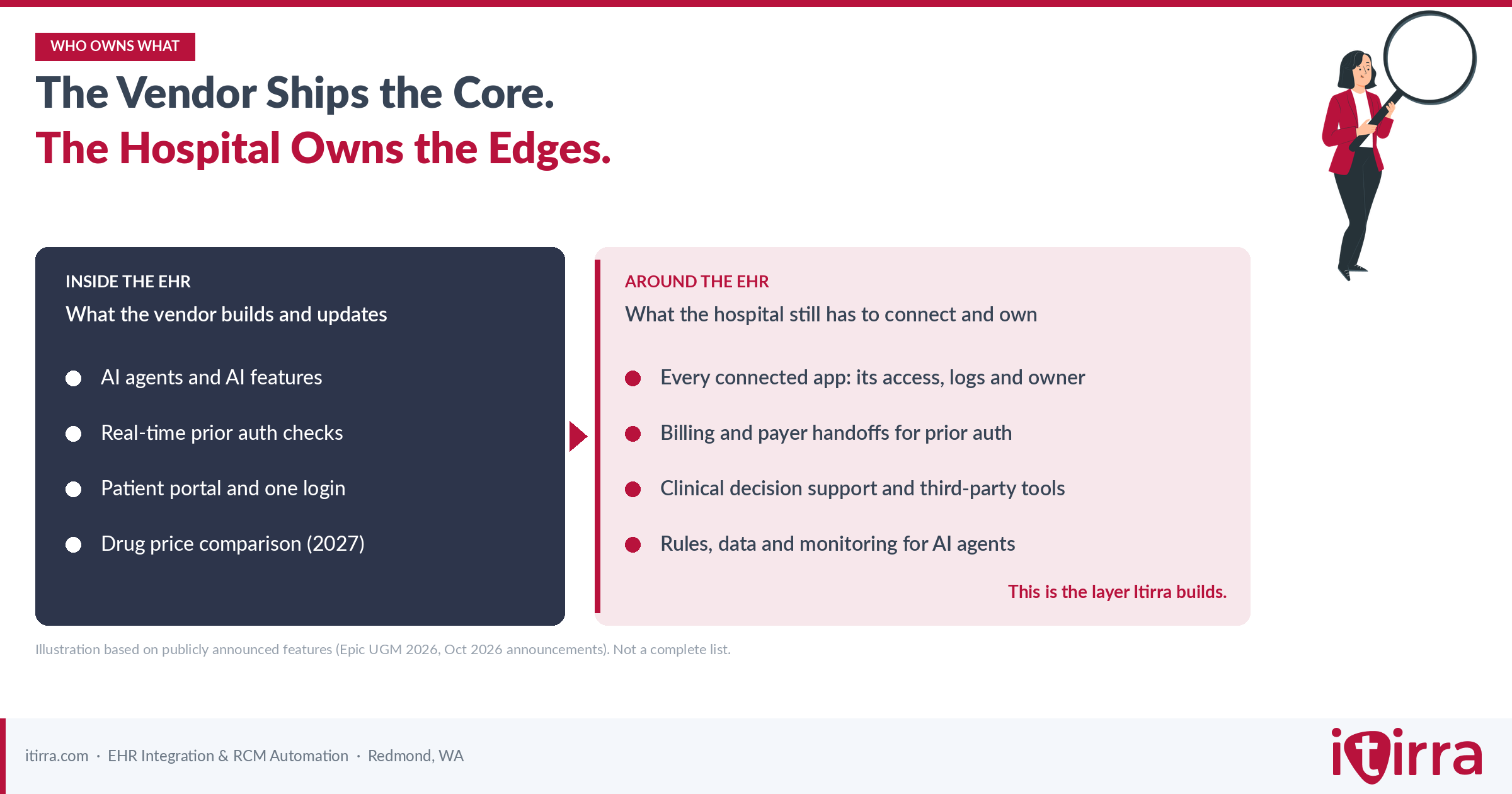
More of the workflow moves inside the EHR, and more of the risk sits at its edges. None of it asks a hospital to replace its EHR, the point we made last week in Keep the EHR. 5 Ways to Fix the Workflow. Here is what we’ll be watching; this is our read of public announcements, not insider information.
- AI reaching into other apps. Through Connectors, the AI inside the EHR will start working in the billing systems, payer tools and third-party apps around it. That’s where the gaps will show.
- A harder look at every connected app. Epic paused most new development in September to focus on security and warned customers to expect more urgent fixes (Fierce Healthcare, Sept 2026). Integrations without documented permissions and a named owner will be flagged first.
- Every connection has a cost. More apps mean more traffic and more hardware. Connected apps belong in the infrastructure budget, not just the app inventory.
- Rules for AI agents. Costco’s 1,000 calls a day show what ungoverned agents look like from the receiving end. Someone inside the hospital has to own what an agent can see and touch.
Agenda sessions from Mass General Brigham, OHSU and Children’s Hospital of Philadelphia were about the same unglamorous work: evaluating apps, configuring them and moving them from pilot to production (Open@Epic 2026 agenda). We know that work well. Itirra built AIDA Healthcare’s FHIR app, which runs embedded in Epic: case managers open it with single sign-on, and referral data moves through APIs instead of fax.
What does it mean for companies that build healthcare software?
Connectors open a new route into Epic, next to the SMART on FHIR apps and API integrations vendors use today. Three decisions follow:
- Does a Connector fit the product? Epic’s examples are complementary tasks. How Connectors treat products that overlap with Epic’s own AI hasn’t been tested (healthsystemCIO, Oct 2026).
- When to build? MCP may change later, and Epic is also releasing a public MCP server for developers’ AI coding tools (Becker’s Hospital Review, Oct 22, 2026).
- Who pays and who approves? Epic will charge developers to list Connectors, and every hospital customer runs its own security review (Fierce Healthcare).
Connectors don’t replace a product’s existing integrations. The near-term job is still an app that works inside the clinician’s workflow, with permissions a hospital can approve quickly. That’s what we build for healthtech companies: SMART on FHIR applications for Epic environments and the integrations around them.
What should a hospital ask before approving a Connector or any new app?
Before turning on a Connector or any third-party app, ask five questions:
- What exactly can it read, and what can it change? Get it in writing, by data type.
- Is every action logged, and can your team see the log?
- How is it switched off, and what happens to work in progress?
- Who owns it after go-live, on your side and on the vendor’s?
- When an action across two systems fails, who finds out and who fixes it?
The same five questions work for every app already connected to your EHR. That’s the layer we work in every day at Itirra: EHR integration, SMART on FHIR applications, clinical decision support and revenue cycle automation. Most engagements start with 10 to 40 hours of scoping, and you own what we build. Want to run these questions against your own setup? Book 30 minutes with our team.
Your EHR has a plan. Make sure everything around it has one too.
Frequently Asked Questions
What did Epic announce at Open@Epic 2026?
On October 21, 2026, Epic announced Connectors, which let its AI tools pull information from third-party apps and complete tasks in them, starting March 2027. The keynote also covered FHIR notifications to reduce app traffic, Bulk FHIR exports up to five times faster and MyChart sign-up with a mobile driver’s license (Epic; Becker’s Hospital Review, Oct 22, 2026).
What are Epic Connectors, and how does a hospital approve them?
Connectors are integrations, built by app developers on the Model Context Protocol at launch, that let Epic’s AI tools read from and act in other apps. The health system reviews what each one can do, read and change, and data doesn’t flow until its security, legal and compliance teams approve (Fierce Healthcare, Oct 2026).
What should a hospital ask before approving an Epic Connector?
What it can read and change, whether every action is logged and visible, how it is switched off, who owns it after go-live, and who finds out and fixes it when an action across two systems fails.
When are prior authorization APIs required?
Under CMS-0057-F, impacted payers must have a Prior Authorization API live by January 1, 2027. Eligible hospitals attest to at least one electronic prior authorization request during the CY 2027 EHR reporting period (CMS).
How many apps are connected to your EHR right now, and who owns each one?
30 minutes, no pitch deck
Let’s talk about your project.
Book 30 minutes to walk through what’s connected to your EHR and what changes for you in 2027. Building healthcare software? We’ll talk through Connectors and your Epic integration path.
Sources
- Introducing Connectors: A New Way for Apps to Communicate With Epic. Epic, Oct 21, 2026. Source for what Connectors do, the examples, supported AI tools and Showroom availability from March 2027.
- What Epic revealed at its developer conference: 10 takeaways. Becker’s Hospital Review, Oct 22, 2026. Source for the opening keynote (Seth Howard), Connectors timing, MCP server, FHIR notifications, Bulk FHIR, imaging, MDL sign-up, government pledges, the pharmacy panel and the VA panel.
- Epic launches Connectors to link its AI tools with third-party apps. Fierce Healthcare, Oct 21, 2026. Source for MCP, health system approval before data flows, testing by end of 2026 and developer fees.
- Epic’s Connectors Will Let Its AI Agents Complete Tasks in Other Vendors’ Apps, Reopening the In-Suite Question for CIOs. healthsystemCIO, Oct 22, 2026. Source for the open questions on permissions, switching off, audit logs and accountability.
- Optimizing Hospital Discharge with a FHIR App in Epic (case study). Itirra. Source for the AIDA app: embedded in Epic, single sign-on, API-based referrals.
- Open@Epic 2026 Agenda. Open@Epic, Oct 20–22, 2026. Source for session topics, health system speakers and the drug affordability panel.
- Open@Epic to Return in 2026 as Healthcare Data Sharing Accelerates. Epic, Apr 6, 2026. Source for event dates, monthly exchange volume and Showroom app count.
- 5 things to know about Epic’s 2026 UGM AI announcements. Becker’s Hospital Review, Aug 18, 2026. Source for 120 AI features, 2027 availability and real-time prior authorization checks.
- Epic debuts instant prior authorization checks at 4 health systems. Healthcare Dive, Aug 18, 2026. Source for the first health systems, payers, 16 payers in testing and the CRD API.
- Epic ramps up cybersecurity focus, but AI roadmap still on track. Fierce Healthcare, Sept 23, 2026. Source for the development pause, urgent security fixes and the unchanged roadmap.
- Epic launches new Prescription Marketplace price transparency tool. Healthcare IT News, Oct 16, 2026. Source for Prescription Marketplace partners and summer 2027 release.
- CMS Interoperability and Prior Authorization Final Rule (CMS-0057-F). CMS. Source for the January 1, 2027 payer API deadline and hospital attestation.